
John Shedden’s Fjällräven Classic 8th-12th August 2014 (Part 1)
The last minute call to join the Fjallraven Classic Trek in Swedish Lapland, as a guest of Fjallraven, came just a couple of weeks before the event. A call from our rep Ross explained that someone had dropped out and a place was available but he needed to know by the end of the day. Thankfully when asked if I could go my diary magically became clear for that week, decision made there followed some frantic web searching to find flights.

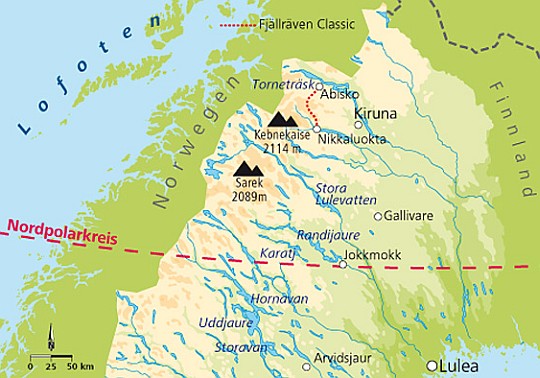
The Fjallraven Classic is a 110km trek through the mountains of Northern Sweden 200km inside the Arctic Circle and 2014 is the tenth anniversary of the event. Started in 2005 Fjallraven wanted to move away from the very competitive lightweight mountain racing scene of the time and create an event that was more inclusive and less competitive, where participants could travel at their own pace, with time to appreciate this awesome scenery.
Flying into Kiruna from Stockholm is quite an interesting experience, as after an hour and a half of forests and lakes you barely see a road or building until a couple of minutes before you touch the tarmac. The dramatic thunder storm which started as we got off the plane added to the sense of remoteness. We were met by our guides for the trek Mats and Emil who took us to the event centre in Kiruna. Here participants would register and pick up food and fuel supplies and buy last minutes items that had been forgotten, even walking boots were on sale!! Following this we enjoyed a fabulous dinner courtesy of Stephan and his wife at the dog sledding centre at Poikkijavi and were then taken by boat across the river to our cabin accommodation for the night.

Day 1 Nikkaluokta – Kebnekaise – Lillberget (25km)
After the start in Nikkaluokta, the trail winds through mountain birch forests and over plank-crossed bogs. At the beginning of the trek, it was quite crowded and even though the path was wide it was still quite rocky. The crowds started to thin out after a couple of kilometres and as this first day was unusually hot at 25°C the shade from the trees in the early part of the walk was really welcome. At the six kilometres you reach Lap Dånalds, which serves reindeer burgers, on the shores of Laddjujarvi with beautiful views down the lake towards the craggy top of Tuolpagorni. The trail continues close to the lake before becoming more narrow and rocky as it rises towards Kebnekaise Mountain Station, our first checkpoint, where we stopped for a cold beer. The best camping spots were a little further so we walked another 5km to camp on an open col below the impressive Tuolpagorni.


Day 2 Lillberget – Singi – Salka (22km)
The morning saw some hazy cloud which kept things cool until later in the day. This is a fantastic part of the trek, the scenery if very much like the Scottish Highlands but on a much grander scale with the Red Deer herds replaced with Reindeer herds. The huge valley of Ladtjovagge is flanked by fantastic mountains which rise majestically as you walk through one of the most beautiful valleys of the trek. The high point before the descent to the Singi Mountain Hut gives stunning views over Tjäkjavagge towards Kaitum. Our next checkpoint Singi, lies open and bare in the shadow of the Ladtjovagge and Tjäktjavagge valleys. Our goal for the day is to continue to the Salka Mountain Hut, another 12.5km. The Tjäkjavagge is a huge valley and the Tjakja Pass beyond Salka, the high point of the trek at 1100 metres, can be seen in the far distance. We camped by the river near the Salka Mountain Hut, where we were able to buy a beer and enjoy the cool evening breeze.


Day 3 Sälka – Tjäktja – Alesjarure (26km)
This was going to be a tough day with the longest distance, the highest climb and some of the roughest terrain. The Tjäktja Pass is one of the more strenuous parts of the trek, in reality it’s not a massive climb but with a heavy pack and 3 days into the trek a steady pace was needed. On the other side of the Tjäkja Pass stretches a fascinating and very unique moonscape. The route passes to the east of Tjäktja Mountain Hut with the actual checkpoint a couple of kilometres further on. After a good break for lunch we continued through the broad and fairly flat Allesvagge heading for our next overnight camp near the Alesjarure Mountain Station. At first sight the little cluster of huts looked close with the afternoon sunlight on them but the scale of this place is deceptive and it took us another 2 hours to reach them. We camped just beyond the Mountain Huts on a small hill overlooking the lake. It’s easy to forget that the snow patches in the surrounding mountains are actually glaciers but the beautiful milky green waters of the lake was a sure reminder. I decided that after 3 days perhaps I ought to brave the wood burning sauna, perched above the lake on a rocky outcrop, where you have to chop your wood and collect your water. Well worth the effort although I did stop short of jumping in the lake afterwards as some people, mainly the Finns, were doing. The sauna followed by an evening round a camp fire made for the perfect end to day 3.


Comments are closed here.