
Trekking Poles, what are they good for?
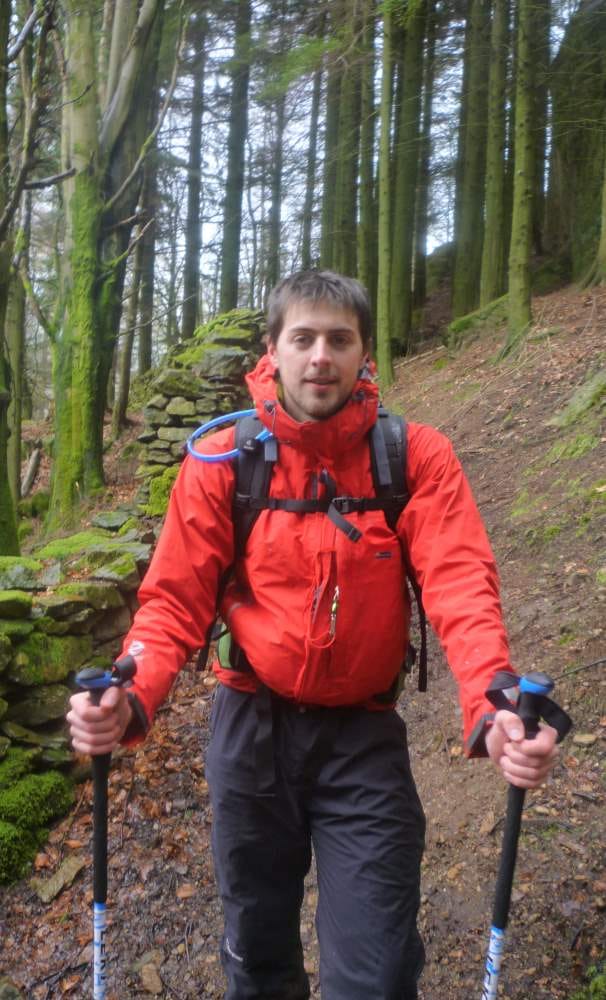 Well the answer seems to be, pretty much everything. The humble walking stick has seen a fair transformation in the last century and whittled wood has been replaced by folding, carbon poles with anti-shock and ergonomic grips. Their purpose remains the same though; to help you walk, whether you need extra stability on tough terrain, to take some strain off your knees in descent, or for extra power getting up the hill. In all honestly, it is surprising that more people don’t use them.
Before this weekend I had never used a set before and knew of the benefits poles provide as abstract knowledge rather than experience. With a trip to the Lakes planned, I decided to borrow a pair and see what they were all about.
On Saturday morning we parked on the side of Thirlmere at Dob Gill car park and headed up through the woods to Harrop Tarn. I’d borrowed a pair of Leki Poles, which had a single, speed adjust lock and an extended foam grip. They also had a neoprene strap which I quickly gave up on in favour of using the extended grip.
My first impression of the poles was that they were unwieldy, though this soon passed as my arm and leg movements synced together. The path up to the tarn is narrow and rocky and recent felling has left numerous logs on it that need to be negotiated. On this first test I wasn’t blown away by the poles. They had certainly taken some of the strain off my thighs in ascent and been useful in negotiating some of the debris, but had at the same time got in the way when clambering over some sections.
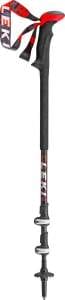 From Harrop Tarn our walk took us west up onto Nab Crags. The poles came into their own on this rolling terrain and I found myself getting into rhythm, very much like on a cross-trainer at the gym. The poles I had borrowed had an extended grip down the shaft which meant I could simply change how I held them on ascent rather than constantly adjusting the length.
Having a set of poles to rely on, I did find myself picking tougher routes up the hills which became simple for me but much tougher for my pole-less partner to negotiate. From Castle Crag we took a pole apiece and began to traverse east. With only one pole I quickly found that rather than using it to speed along it became entirely a tool for getting down difficult sections. In a very steep gully of slippery grass we had to rely on them entirely to keep on our feet, zig-zagging across and keeping the poles in our downhill hands. We found the quick-lock system on the poles especially helpful here as it took only seconds to lengthen them before descending.
The final test I gave the poles was to see how packable they were. Scrambling over a section of felled trees where they were in the way I strapped them to my bag, only to find that they poked up a good 20 cm above my head; the problem with having a 2 section pole rather than a 3. For the most-part, they stayed in place until an overhanging branch and fence post conspired to take one of them off my bag.
Having returned my borrowed poles I am intent on purchasing a pair of my own, though I’ll be looking out for a set that are more compact such as the Black Diamond Collapsing Poles. My opinion of walking poles has changed and rather than thinking of them just as an aid for aching joints I see that they can give you more freedom in the hills, letting you walk further and in areas where your walking boots alone wouldn’t keep you on your feet. Whether I opt to carry the pair or just go solo will depend mostly on the terrain, though for most hill-walks I think having a pair would be beneficial.
Comments are closed here.