
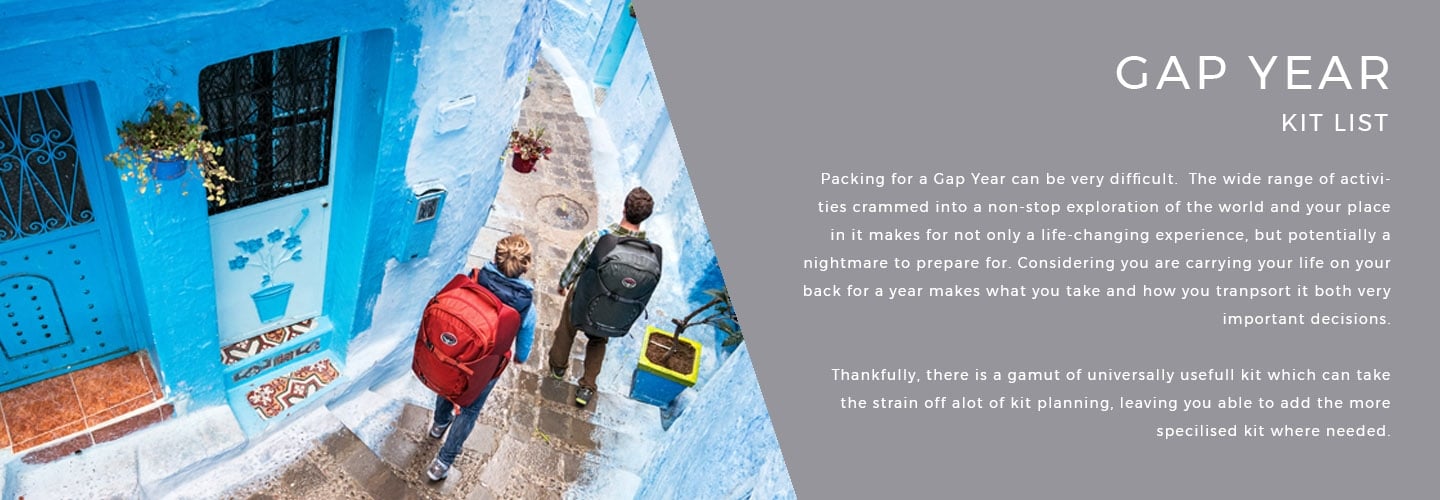
If your heading on a gap year it's worth spending some serious time considering what to take with you and how to store it. Most backpackers are limited by the amount that they can easily carry and everyone always wishes they'd brought less. The general rule should be, take as little as you can get away with, be that one less pair of shoes or leaving the sleeping bag behind. For an extensive list of items you may want on your travels download our Gap Year Kit List
What you take will of course depend on where your heading and what your planning to do when you get there. Below are a few of our tips on preparing for your Gap Year.
Luggage:
The humble backpack is still the global symbol of backpackers, though the options available are no longer quite so humble. Here are a few suggestions:
| Travel Bags | Rucksacks | Duffel Bags |
|---|---|---|
| Travel Bags are a great option for backpackers who are looking to jump from hostel to hostel. These bags offer the convenience of packing a suitcase with the comfortable, rucksack carrying system. Usually with big zip openings and often with detachable day sacks, they are a very convenient option. Some Travel bags also come with wheels | Though less convenient than a travel bag for lengthy stays, a rucksack is a more comfortable option if your looking to spend a few days trekking. They also tend to be lighter and more streamlined which is convenient when making your way through crowded areas or through buildings. | Minimalist, these bags tend to be fuss free but not ideal if you need to travel much with them on your back. |
 |
 |
 |
Day Pack
When you've left your rucksack at the hostel you'll likely need a daysack with you when your exploring the area or as your carry on to busses, trains and aeroplanes. Ideally you want something lightweight that will pack away. You just need to decide on the right balance between size and comfort.
Clothing:
There is a difference between a traveller and a tourist and it's easy to start packing your gap year bag like your going on holiday. You'll quickly find yourself out of space or fed up with the weight if you do. Here are a few handy tips to keep your travel wardrobe in line and practical.
• Keep it lightweight and packable
• Take as little as possible and only take what you expect to use
• Try to mix and match items so that you can wear everything with everything.
• Opt for quick drying fabrics, if you're moving between hostels every other day you don't want to be stuck with a bag of washing you can never get dry.
• A machine wash may not be available all that often so take items you are happy to wash in the sink and hang out.
• Check the climate of where your going when your going so that you know what weather to expect.
• If your planning on an active trip make sure you have clothing that’s comfortable for sports.
• Clothing with UV protection can be beneficial in hot climates.
• Don't take items that are particularly precious or delicate, they may not come back.
• Taking a compression sack or waterproof drybag for your clothes can help save space
Electronics:
Taking obviously expensive items away with you is of course a security risk and makes you a target for thieves. The general advice given is to avoid taking these items and you do have greater piece of mind knowing that you don't have anything extremely valuable with you.
However, a tablet computer can be an incredibly powerful tool for a traveller, allowing you to make advance travel bookings, research the next step of your journey or keep in touch with home. Many hostels around the world offer Wifi whilst fewer have computers available for use. When they do, you are quite often having to queue behind other travellers doing their own research. Having your own tablet also allows you to avoid shelling out by the hour in internet cafes.
As mentioned previously, this really only covers the basics. A gap year taking in the African Desert AND some Arctic dog-sledding will have a much more challenging kit list than backpacking around South East Asia (though not without its challenges). Do your research before you go, travel as light as possible, expect some hardships and be as flexible as possible!
